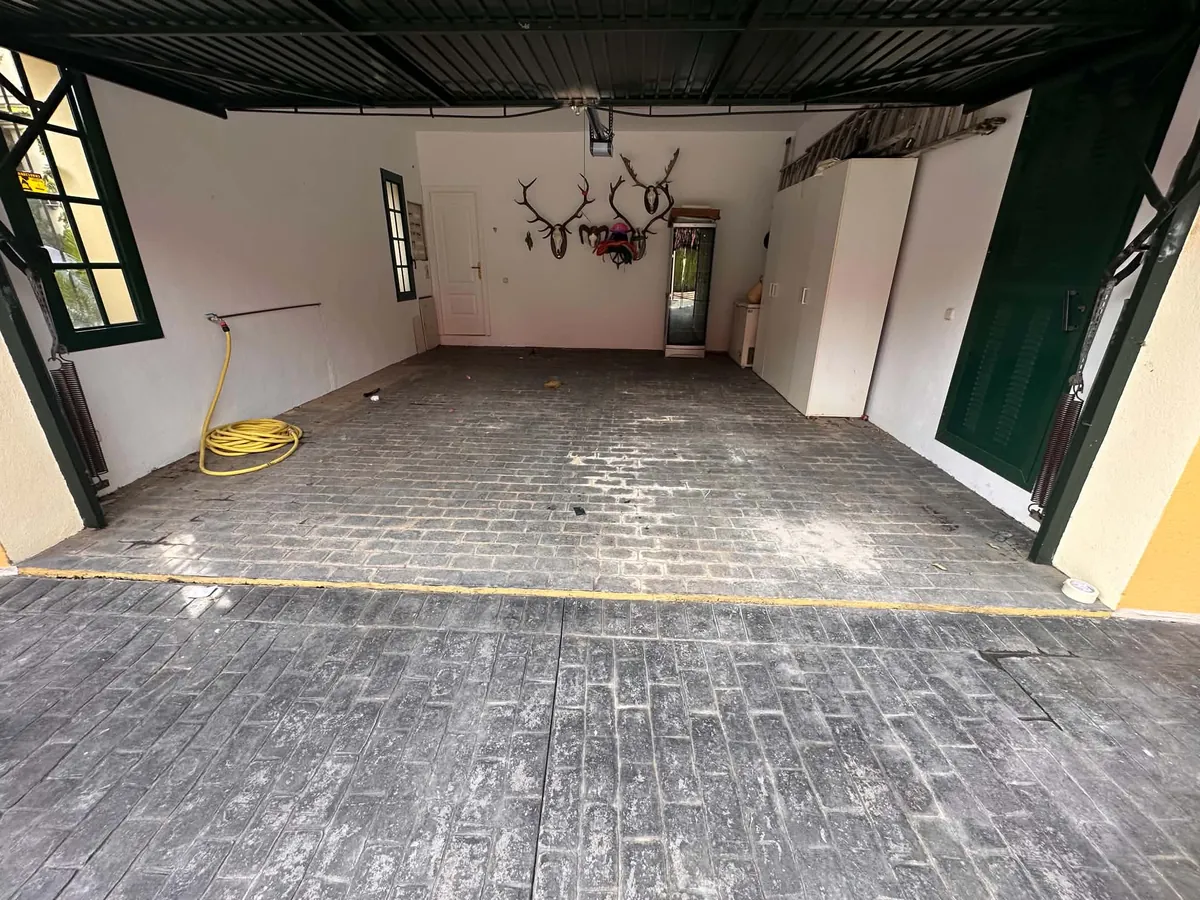
Why Imprinted Concrete Fades, Turns Chalky or Goes White
Imprinted concrete fades because its coloured surface and sealer are worn down by sun, water and traffic; it goes white mainly when an old sealer clouds over or when salts are drawn to the surface by moisture. Knowing which of these you are looking at tells you whether a clean, a recolour or an investigation into damp comes first.
Send us a photo and the m²Where does the colour in imprinted concrete actually sit?
Mostly in a thin top layer. Stamped concrete is typically coloured at the surface while the slab is being laid, and then sealed. That makes the finish attractive when new, but it also means the colour lives in the part of the concrete that takes all the weather and wear.
Once the protective sealer has worn through, the coloured surface is exposed directly. From then on fading speeds up, because every hot afternoon, every rinse and every car tyre takes a little more of the colour away.
What makes stamped concrete fade on the Costa del Sol?
The combination of strong sun, outdoor living all year and surfaces that are washed often. Intense sunlight weathers both the sealer and the colour; regular washing, especially with harsh products or very close pressure jets, accelerates the wear; and the surfaces are used almost every day.
- Sun: open driveways, terraces and pool surrounds receive the full force of it.
- Traffic: tyres turning on the same spot and feet following the same routes wear lanes into the colour.
- Water: pool splash, irrigation spray and rain run-off in the same places.
- Cleaning habits: aggressive chemicals or a jet held too close can strip what is left of the sealer.
None of this means imprinted concrete was a bad choice. It means the finish needs renewing from time to time, which is what a recolour with resin paint is for.
What are the white or cloudy patches?
There are two usual suspects, and they look similar from a distance. The first is the old sealer itself turning milky or cloudy, often where moisture has been trapped beneath it. The second is a mineral bloom: salts carried up through the concrete by moisture and left behind as a white deposit when the water evaporates.
| Sign | Likely source | What it suggests |
|---|---|---|
| Milky film that looks like it is inside the shine | Clouded sealer | Remove or prepare the failed coating before a new finish |
| Powdery white crust that brushes or washes off | Mineral deposits | Check where the moisture is coming from |
| White marks that return after rain in the same spots | Ongoing moisture | Investigate drainage or damp before coating |
| Overall chalky pale look | Weathered colour and worn sealer | Clean and recolour |
These are general indications, not a diagnosis. Photos taken both dry and after rain help a lot when we assess a surface remotely.
Why does a driveway fade unevenly?
Because the forces that cause fading are not spread evenly. The strip where cars turn into the garage, the part of the terrace that is never shaded and the area around the pool steps all lose colour faster than corners under a pergola or along a shaded wall.
The result is a patchwork of tones that makes the surface look neglected even if it is structurally fine. That contrast is one of the main reasons owners start looking into faded imprinted concrete restoration.
Is fading worse around swimming pools?
It often is. Pool surrounds combine full sun, constant splashing, sun cream, wet feet and frequent rinsing, all on the same surface. The area near the steps and the shallow end, where people get in and out, usually suffers first.
Whether a particular coating stands up well to pool water and pool chemicals is a matter for its data sheet (to be verified per product). Our page on pool deck restoration explains how we approach that question.
Can white marks just be cleaned off?
Sometimes, partly. Surface deposits and dirt often come away with a thorough wash. A clouded sealer, on the other hand, is in the coating, so washing alone will not clear it; the failed film has to be removed or properly prepared.
If the marks come back every time it rains, cleaning only treats the symptom. In that case the moisture source deserves attention before any new coating goes on, because water pushing up from below can lift a fresh finish too.
When is fading a sign of something more serious?
When it appears together with structural symptoms: slabs at different heights, wide or widening cracks, hollow-sounding areas or crumbling surface. Those point to the base or to water damage, and they change the decision from recolour to repair or replacement.
Our guide on repairing or replacing imprinted concrete covers those signs, and the Marbella project guide shows what a faded but sound surface looks like before and after.
What is the right fix for a faded surface?
For a sound slab whose colour has weathered: clean, repair and recolour with two coats of synthetic resin paint. For a surface that is only dirty: a professional clean may be enough. For a surface with persistent damp or structural damage: investigate and fix that first.
Frequently asked questions
Is it normal for new imprinted concrete to fade?
Some change in colour over time is normal for any exterior surface exposed to sun and use. How quickly it happens depends on the original sealing, the exposure, traffic and how the surface has been cleaned. Uneven, patchy fading is a sign that the protective layer has worn in places.
What causes a milky white haze on stamped concrete?
A milky haze within the shine usually points to the sealer itself clouding, often because moisture got trapped under it. It sits in the coating rather than in the concrete. The fix involves dealing with the failed sealer before applying a new finish.
What is the white powder on my imprinted concrete?
A powdery white crust that brushes or washes away is typically a mineral deposit left behind when moisture carrying salts evaporates at the surface. If it keeps coming back, the moisture is still moving through the concrete, and that should be understood before coating.
Does sun alone cause stamped concrete to fade?
Sun is a major factor, but rarely the only one. Traffic, water, cleaning products and the condition of the sealer all play a part. That is why two driveways in the same street can look very different after the same number of summers.
Can pressure washing make fading worse?
It can, if the jet is held too close or used too aggressively on a surface whose sealer is already weak. Professional cleaning before recolouring is different: the aim there is to remove everything loose so the new coating bonds properly.
Why is my pool surround whiter than my driveway?
Pool surrounds get splashed and dried constantly, and pool water and sun cream add to the mix. That can cloud old sealers and leave deposits faster than on a driveway that stays mostly dry. Each surface is assessed on its own before recolouring.
Will a recolour hide white marks?
A recolour covers what remains after cleaning and preparation, so a uniform tone replaces the patches. If the white marks are caused by ongoing moisture, though, they can affect the new coating too, which is why we ask about damp before quoting.
Does a darker colour fade faster?
How a colour performs over time depends on the specific product and is described in its data sheet. Darker tones do show a loss of depth in a different way from lighter ones, and they absorb more heat. We discuss these trade-offs when choosing the colour.
Should I seal my imprinted concrete before it fades?
Maintaining the surface before the colour has gone is generally easier than restoring it afterwards, because less preparation is needed. Once the colour has weathered, a clear sealer cannot bring it back and a coloured finish becomes the realistic option.
How can I tell if fading is just cosmetic?
If the surface is level, firm underfoot, without wide cracks or crumbling areas, and the only issue is colour, it is cosmetic. Send photos and we will confirm whether a clean and recolour is likely to be enough.